Kamboji: We Kept Playing Cabo, So I Built It
There is a card game my friends and I play almost every time we sit together. Someone pulls out a deck, four cards go face-down in front of everyone, and for the next hour nobody trusts anybody.
Yesterday we played it again. When we finished, one of my friends said, "Let's build this." I thought about it for a second and then thought, why not.
So I did. It is called Kamboji, and you can play it right now on your phone with your friends. No app, no sign-up.
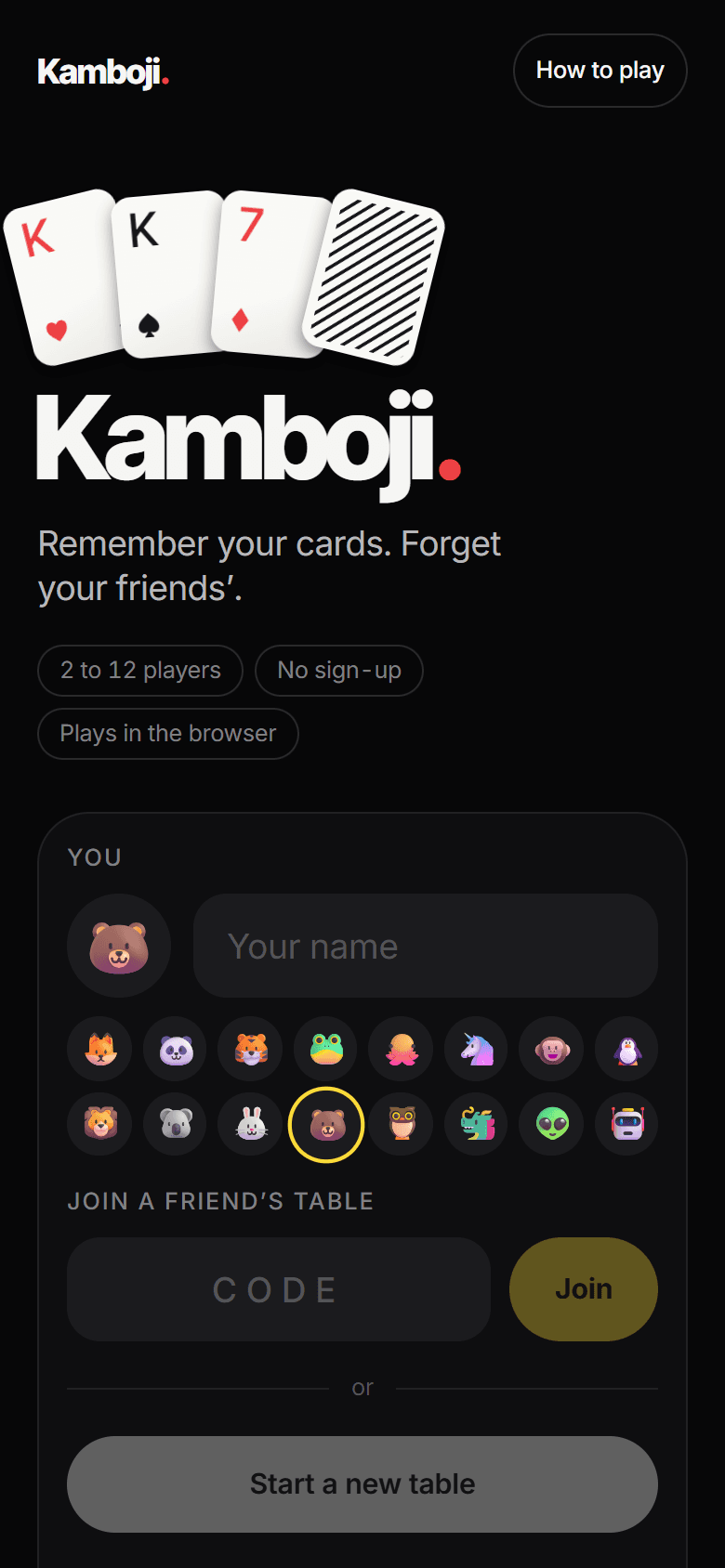
The game it comes from
The game we play is a version of Cabo, a card game designed in 2010 by Melissa Limes and Mandy Henning. Cabo itself grew out of an older family game called Golf, where you also try to end with the lowest cards. The official Cabo deck has its own cards numbered 0 to 13, but most people play it with a normal deck, and it goes by a lot of names depending on who taught you: Cambio, Pablo, Cactus, and probably a dozen more.
We call ours Kamboji. Do not ask me where the name came from. It was just what we started shouting.
The whole idea fits in one line: the lowest hand wins, but you can barely see your own cards.
You get four cards face-down. At the start you peek at two of them, once, and then you have to remember them. Everything after that is memory, guessing, and lying with your face.
How a round goes
- 01
Deal four. Everyone gets four face-down cards and looks at their bottom two, once.
- 02
Draw and swap. On your turn, draw a card. Swap it into your hand if it is lower than something you have, or throw it away.
- 03
Use the powers. Some cards do things when they are thrown away. A 7 lets you peek at one of your own cards. An 8 lets you spy on someone else's. A 9 lets you swap a card with someone without looking. A 10 lets you swap and then look at what you got.
- 04
Snap. The moment a card lands on the discard pile, anyone who has the same card can slap theirs on top and get rid of it. Get it wrong and you take a penalty card.
- 05
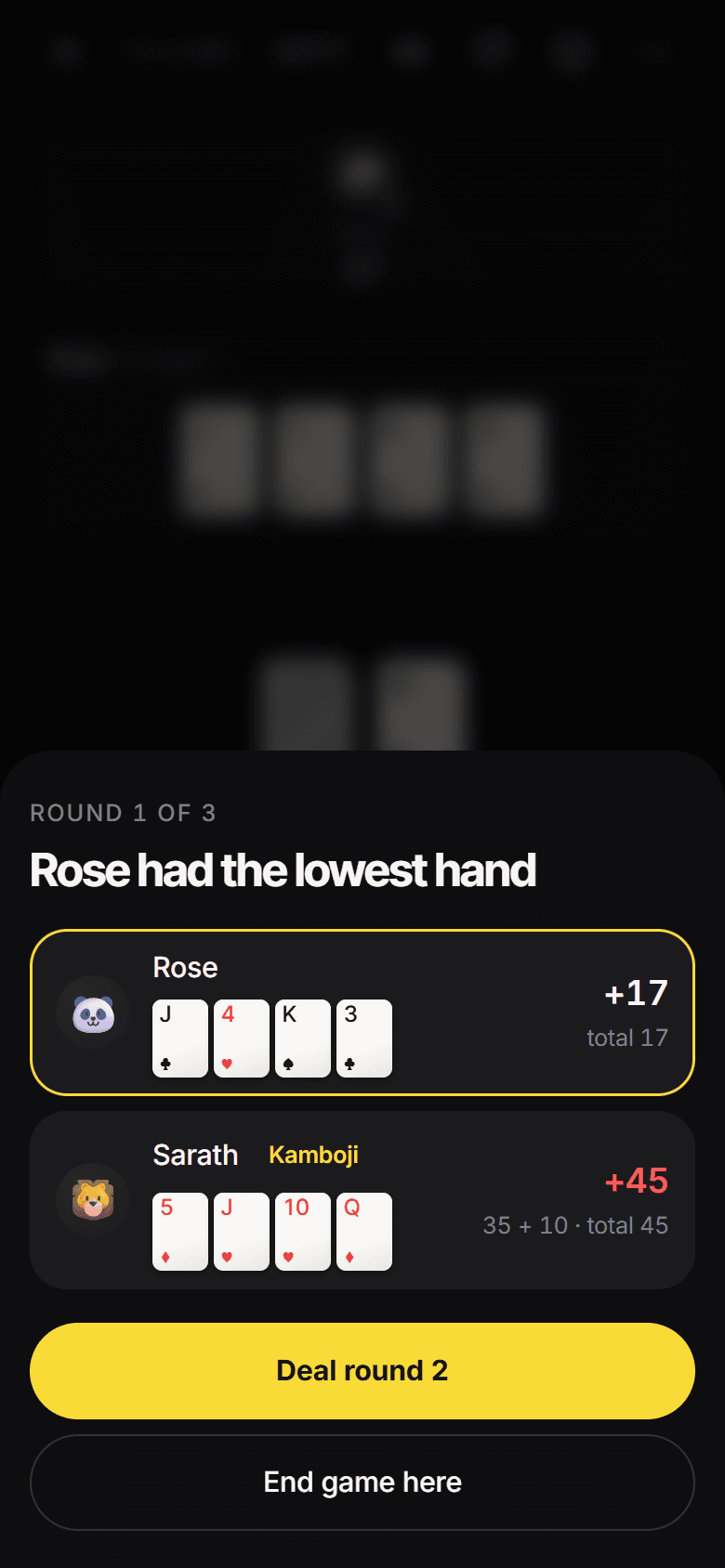
Call Kamboji. When you think you have the lowest hand, call it at the start of your turn. Everyone else gets one more turn, then all the cards flip.
Our house rules
Every group that plays this game has its own rules, and every group thinks theirs are the correct ones. Here are ours, which are obviously the correct ones.
Kings are special. A black king is worth 0 and a red king is worth -1. Everything else is face value, with jacks and queens at 10.
What each card is worth
Lowest total wins, so the two red kings are the best cards in the deck.
Snapping is always on. Anyone can snap, any number of times, until the next player starts their turn. You can even snap someone else's card, but then you have to give them one of yours in return.
Calling has a price. If you call Kamboji and you really are the lowest, your score for the round is 0. If anyone has less than you, you get your whole hand plus 10. Someone once called with 21 and found out the hard way.
The caller's gamble
Hand total vs what the caller actually scores
Call it right and your hand is wiped to zero. Call it wrong and you pay ten extra.
Run out of cards and you are out. If you snap away your whole hand, you score 0 for the round and sit back and watch. When only one person still holds cards, the round ends.
No multi-swap. Some people play that you can swap two matching cards out at once. We dropped it, because it is really the same as swapping one out and snapping the other. One less rule to argue about.
Playing it on a phone
The online version tries hard to feel like the real table. Everyone joins from their own phone with a four-letter room code. Up to twelve people can play, and with nine or more it shuffles in a second deck.
The hardest part of moving this game to a screen was not the rules. It was the table talk. In real life, when someone reaches across and swaps one of your cards, you see their hand move. On a phone, a card just quietly changes.
So now every card that moves actually flies across the screen, with a little swoosh, from wherever it was to wherever it went. If someone swaps your card, you watch it leave your hand and land in theirs.
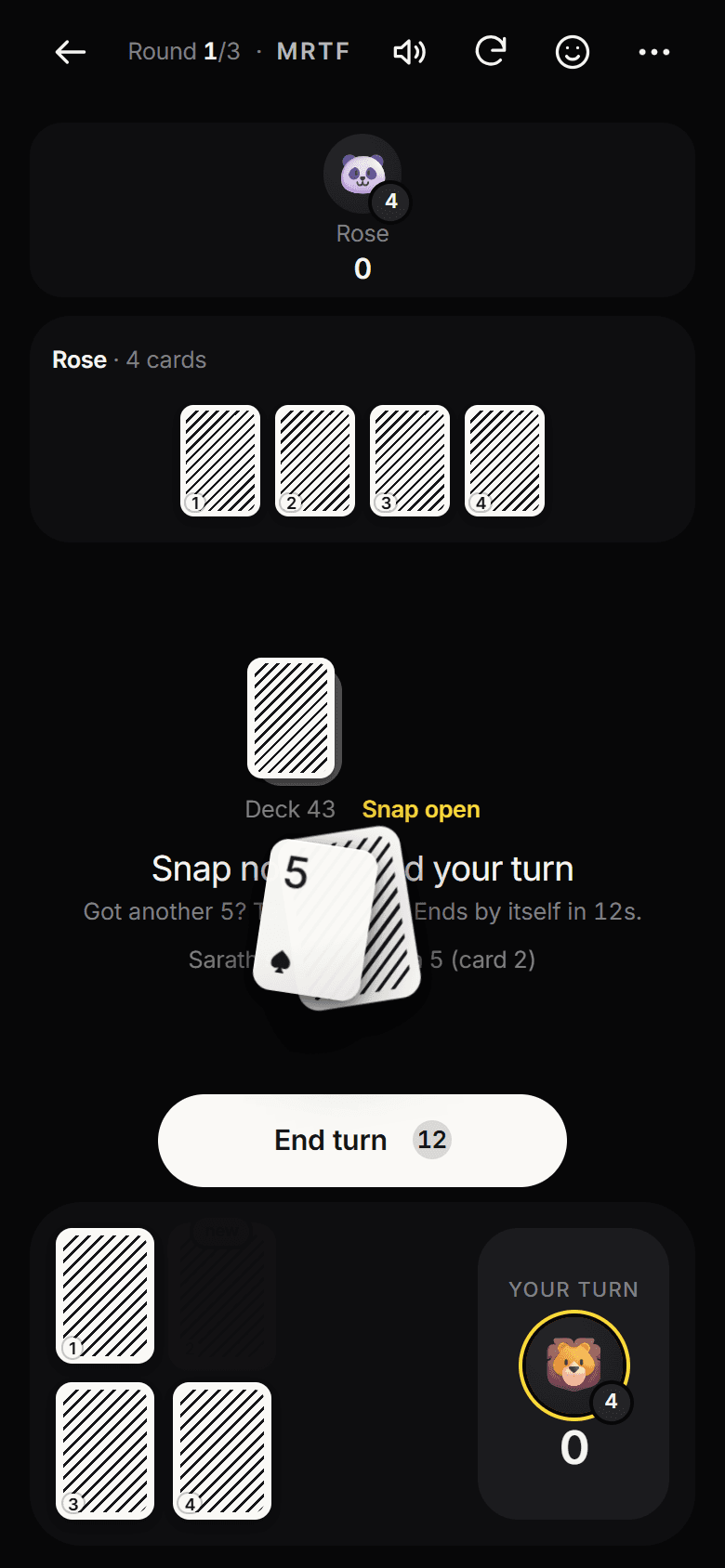
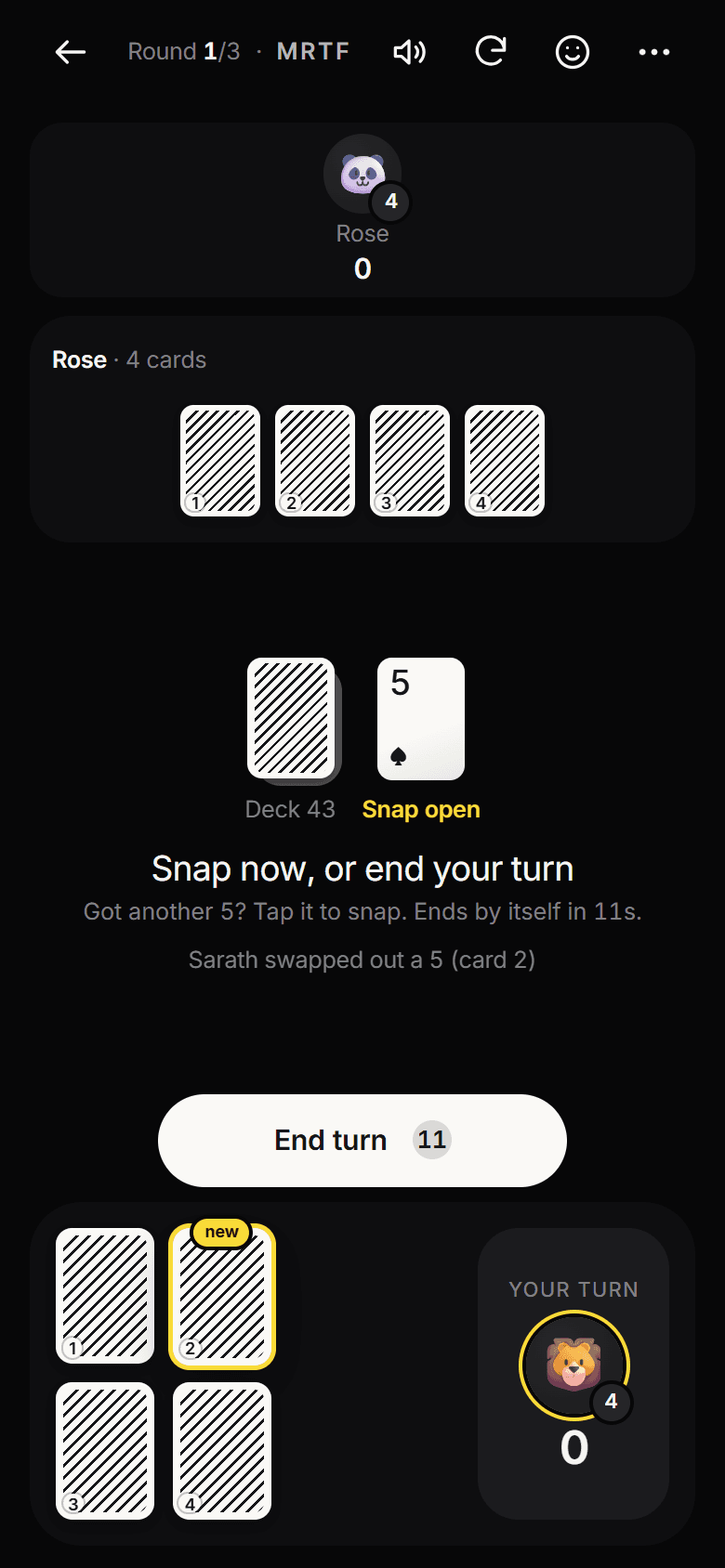
Every card also has a small number in its corner, so when the game says "Rose swapped your card 2", you know exactly which one. Cards that changed recently keep a yellow ring and a little tag like "new" or "⇄ Rose" for about a lap, so you do not miss it while you were looking at your own hand.
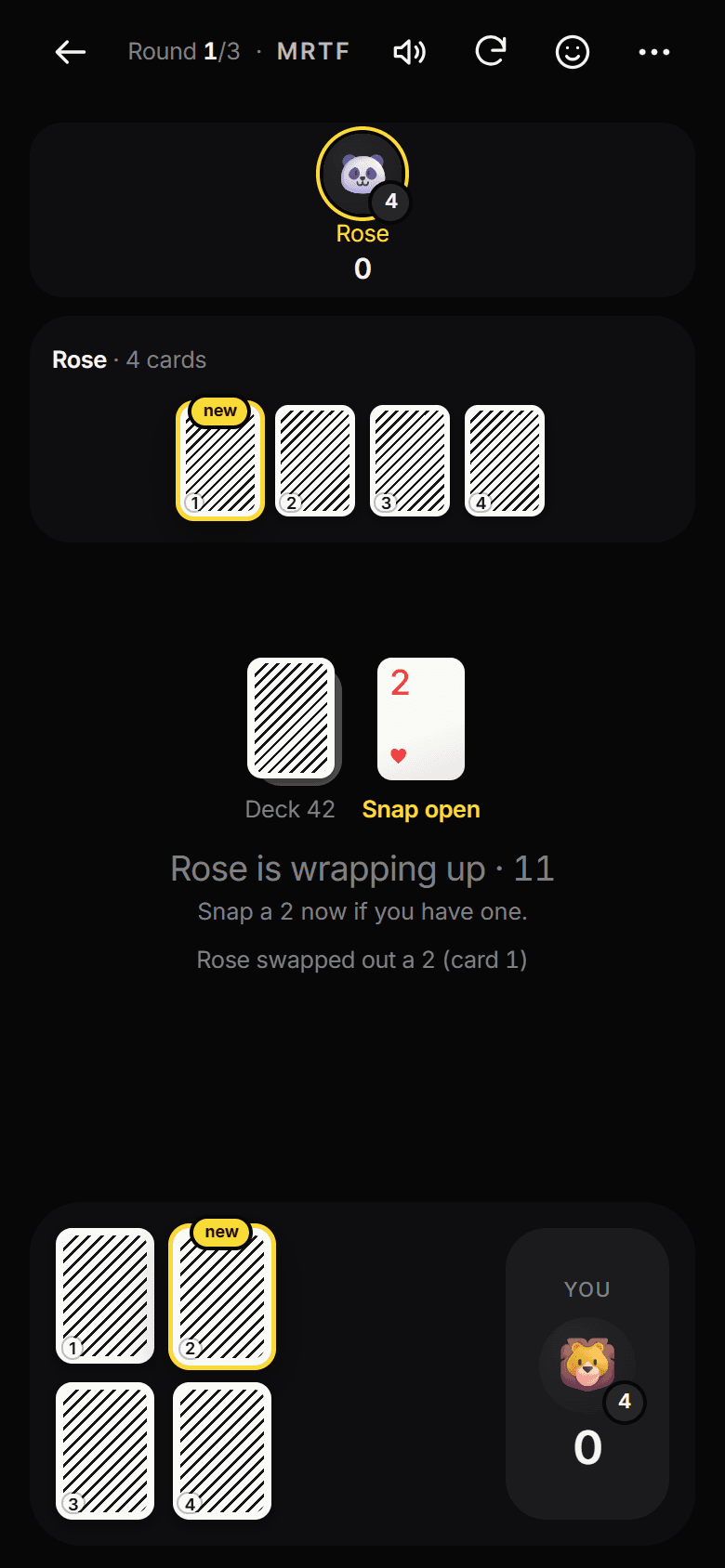
The other thing we noticed while playing was snapping. In real life there is a natural pause after someone throws a card away. Online, the next person could draw instantly and the chance to snap was gone. So now your turn waits after you discard. You snap whatever you need to, then press End turn. If you forget, it ends by itself after a few seconds.
At the end of each round all the hands flip so everyone can see who was lying, and after the last round you get the final standings, round by round.
How it works, lightly
You do not need to know any of this to play, but a few things I cared about:
- Your phone only knows your cards. The server holds the real deck and sends each player only what they are allowed to see. You cannot open the browser tools and peek at your friend's hand.
- Switching apps is fine. Phones love to cut connections when you jump to WhatsApp for a second. When you come back, the game reconnects and puts you right back in your seat.
- If someone drops out, the game does not freeze. After a while, anyone at the table can remove a player who has gone missing, and the game carries on.
It is built with React and TypeScript, with Socket.IO keeping every phone in sync and Redis holding the game state, all running on Vercel.
Playtesting with bots
I built it with Claude Code as my pair programmer, and one fun thing we did was let a group of AI agents play it before any of my friends did. Some played normally, some tried to break it on purpose, and a script played a few thousand random games just to see if the rules ever got stuck.
They found real bugs. At one point a power swap could quietly go wrong right after you swapped a card out. In another case, if the deck and the discard pile both ran out after someone called Kamboji, the table just froze with nobody able to move. Both are fixed now, and the rules have tests so they stay fixed.
Then I played it with a friend, which found the more human problems, like not noticing when someone swapped your card. That is where the flying cards and the End turn button came from.
Come play
That is the story. A game we play anyway, now on our phones, for the days we are not in the same room.
If you want to try it, open kamboji.vercel.app, start a table, and send the code to your friends. There is a full guide if you have never played.
If your group plays this game with different rules, I would love to hear them. Which ones you keep is a big part of the fun.
If this was worth sharing, send it to someone on 𝕏 or LinkedIn. Got a question or a thought? Drop me a message , I read everything. If this was worth your time, .